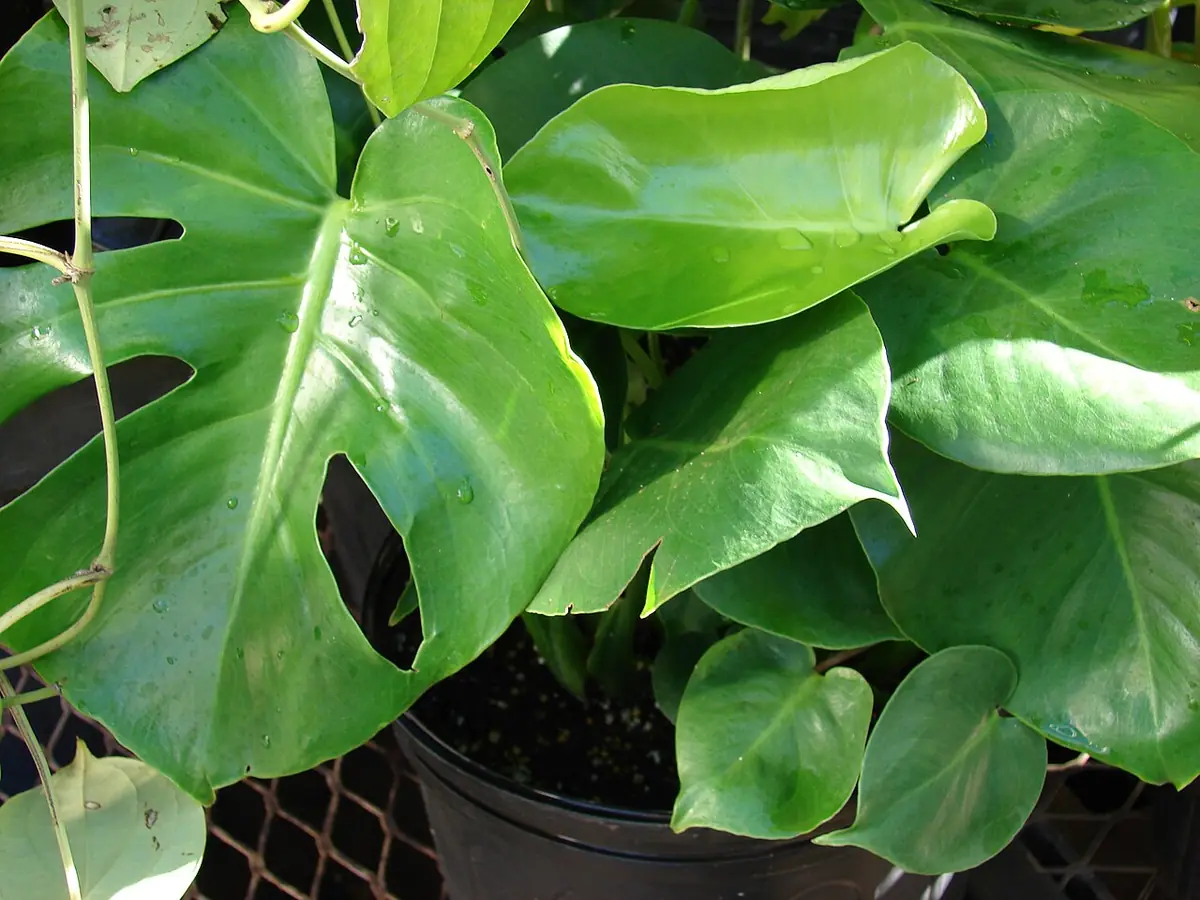
A Monstera needs a support behind its climbing stem, not a bundle of leaf stalks tied together. Find the thicker stem with its nodes and aerial roots, then place a sturdy pole or plank along that side. Attach the stem with soft, loose ties. Leaves need space to turn toward light, so their individual stalks should remain free. Supporting a plant this way preserves its natural shape while reducing the leverage of heavy growth.
Find the climbing stem
Before buying a taller pole, check whether the existing pot stays upright when the leaves extend toward the window. A very tall support cannot compensate for an unstable base. Set the nursery pot on a level surface and inspect its drainage and root space. If the plant is firmly rooted and the pot is stable, support may be the only change needed. Yellowing leaves or persistently wet mix call for a separate root and watering assessment.
Look at where new leaves emerge before choosing the exact position. A Monstera does not have a perfectly symmetrical front, and forcing its stem to bend sharply can split tissue. Offer the support to the climbing side without pressing against a leaf joint. A small plant can be trained gradually; a long, stiff stem may need support along its existing curve rather than being pulled upright in one afternoon.
Fit the support to the plant
Install a support while repotting when possible, so you can see where roots lie. For a plant staying in its current pot, ease a narrow support into a clear edge position and stop if you encounter firm resistance. Do not repeatedly spear the root ball to find a convenient angle. A broad plank, a suitable pole or an independently secured frame can work, provided the material is sound and the finished arrangement remains stable.
Make the first attachment on a strong section of main stem below active growth. Leave enough room for thickening and keep the tie away from emerging leaves. Add another tie only where it improves stability. A dry pole can provide physical support without becoming a moist rooting surface. If you choose a moss pole, assess its moisture separately rather than soaking the whole pot whenever the pole feels dry.
Light influences the direction of future growth as much as a fastening does. Keep the plant in bright light suited to Monstera and introduce stronger exposure gradually. Repeatedly moving it between a dim corner and a sunny window makes its direction harder to manage. Position a supported plant so the newest leaves have room to develop without rubbing a wall, blocking a walkway or pushing against a curtain.
Watch the next growth
Check ties whenever a new leaf opens. A tie that was loose can become tight as the stem thickens, and a heavy canopy may reveal movement at the base. Healthy aerial roots can be guided toward the support without being crushed or forced into tight bends. Older leaves will not suddenly become larger after installation. Judge progress by secure attachment, an upright base and the direction of subsequent growth.
If a stem cracks or the root ball lifts when you adjust it, release tension and stabilize the plant in its present position. Support is meant to carry weight, not straighten damage. Take a photograph from the same spot before the change and compare it after several new leaves develop. That comparison helps distinguish a useful improvement in structure from the ordinary slow change in leaf size as the plant matures.